Not a thousand — eighteen hundred and sixty-four
There are 1,864 islands here, strung along the border where the St. Lawrence leaves Lake Ontario. They are the exposed tips of the Frontenac Arch, an ancient ridge of hard rock that links the Canadian Shield to the Adirondacks you will drive through on Wednesday. To count as an island, the rule goes, a piece of land must stay above water year-round and support at least two trees. One of them holds a single cottage on a rock called Just Room Enough — said to be the smallest inhabited island on earth.
The castle he never finished
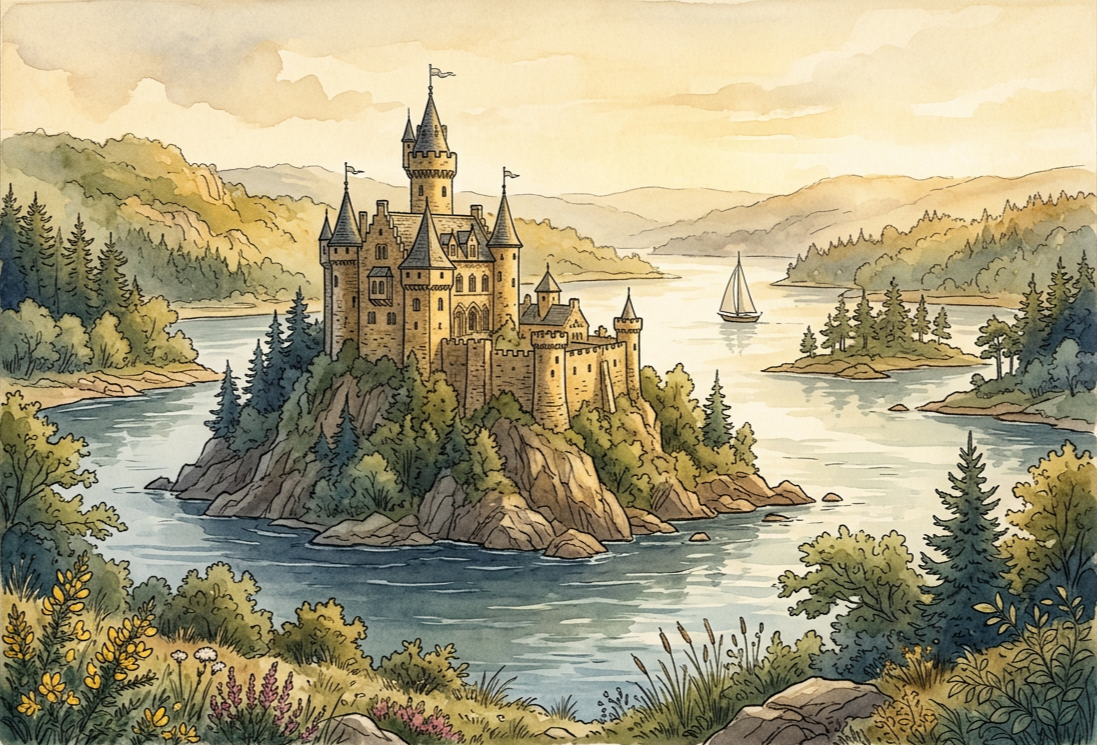
George Boldt ran the Waldorf-Astoria and was, by every account, besotted with his wife Louise. In 1900 he set three hundred workers to building her a six-storey Rhineland castle on a heart-shaped island. In January 1904, with the castle nearly done, Louise died suddenly. Boldt sent a telegram ordering all work stopped, and never set foot on the island again. It sat open to the weather for seventy-three years before anyone tried to finish it.
And yes — the salad dressing
Thousand Island dressing is named for these exact waters. The story goes that Sophia LaLonde, wife of a Clayton fishing guide, served it at shore dinners for her husband's clients. An actress in one of those parties liked it enough to pass the recipe to George Boldt, who put it on the Waldorf-Astoria menu — and from a hotel dining room in Manhattan it went out to the whole world.
Why the signs turn French
In 1535 Jacques Cartier climbed the hill at the heart of the island and named it Mont Royal — the root of the city's name. On the 17th of May, 1642, settlers led by Paul de Chomedey de Maisonneuve and a nurse named Jeanne Mance founded a missionary colony here called Ville-Marie, the City of Mary. It became the fur-trading capital of New France. Britain won Canada in 1763 but let the roughly seventy thousand French inhabitants keep their language and their faith — and four centuries on, this is still the largest French-speaking city in the Americas.