How the gorge was carved
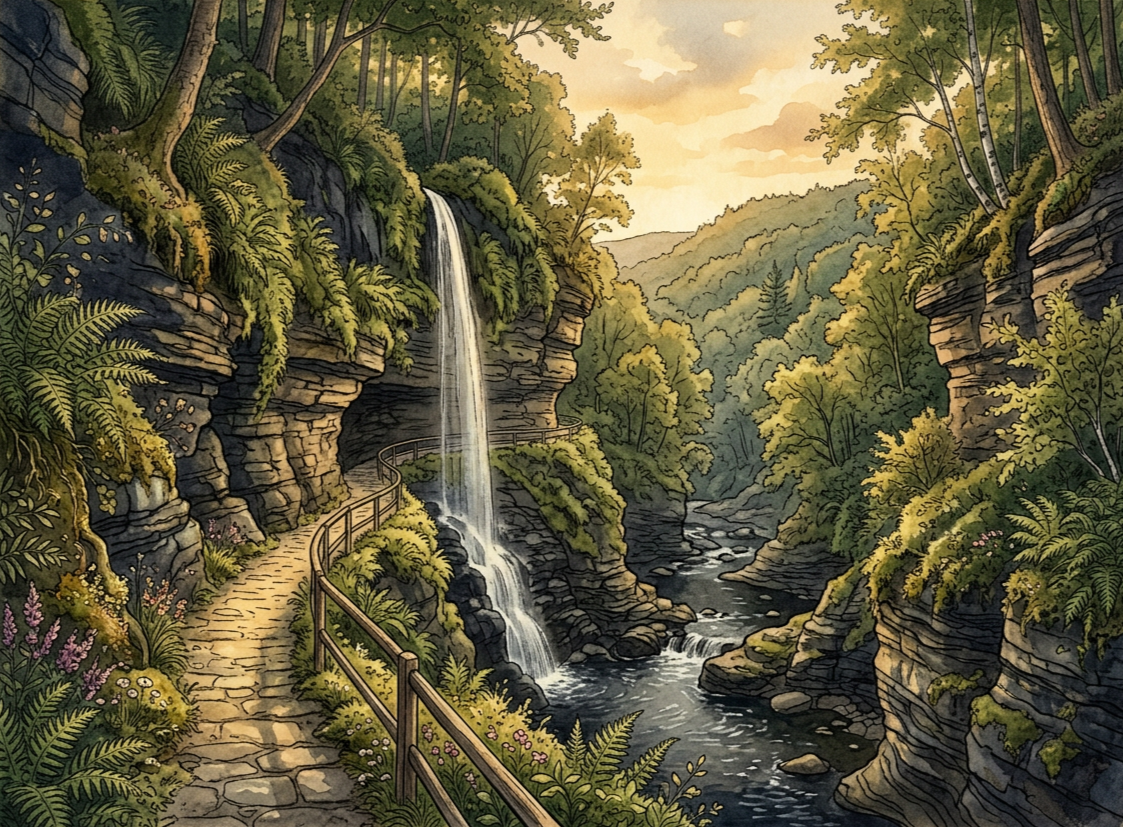
The Finger Lakes are gifts of the Ice Age. Glaciers up to two miles thick gouged old river valleys into deep troughs, and when the ice melted around eleven thousand years ago the troughs filled to make eleven long lakes. Watkins Glen is younger still — roughly twelve thousand years — cut as Glen Creek raced down toward Seneca Lake through soft rock that formed on the floor of a warm sea hundreds of millions of years before. In under two miles the creek drops four hundred feet past two-hundred-foot cliffs, over nineteen waterfalls.
The stairs you are standing on
The stone steps, tunnels and bridges through the gorge are not natural and they are not old. A flood tore through the glen in 1935 and wrecked the trail. The Civilian Conservation Corps — Depression-era young men, paid a dollar a day — rebuilt it by hand out of local stone. Ninety years later you are still walking on their work.
Glass that changed the world
That small city you drove through has quietly remade modern life out of glass. Corning made the envelope for Edison's first lightbulb, then the ribbon machine that made bulbs cheap enough for everyone. Then Pyrex. Then the two-hundred-inch mirror for the Hale Telescope, the windows on NASA's spacecraft, the first low-loss optical fiber — the thing that actually carries the internet — the Hubble mirror blank, and the Gorilla Glass on the phone in your pocket. The museum was a gift to the nation in 1951.
Say it "skinny-atlas"
Skaneateles is an Iroquoian word meaning roughly "long lake," and locals say it skinny-atlas. The lake is one of the cleanest in the country — clear enough that Syracuse draws its drinking water from it essentially unfiltered. Stand on the pier at dusk and you can see the bottom a long way out.